Saturday, July 2, 2011

The Five Senses of Haiti

In Haiti…..

I touched: A whole goats’ head wrapped in cold plastic in the refrigerated meat section of a grocery store; a tattered deck of cards; a farmer’s worn machete; a handful of tiny planting seeds; conch shells lining the top of a wall; banana leaves slick with rain; rain drops sneaking through a tin roof onto my bed; rough wooden carvings; calloused hands and leathery cheeks of countless Haitians; a non-electric iron that grows hot by inserting pieces of charcoal inside.


I smelled: Small charcoal fires in cinderblock houses; pigs wallowing in mud; grilled chicken at a street stall; trash rotting in the streets; shared chunks of watermelon in a crowded van; Caribbean ganja; propane stoves; homemade meat turnovers being cooked at a street stall; incense; trucks sputtering exhaust; sulfur flats where President Duvalier used to dump the bodies of his enemies; freshly woven shopping bags.


I saw: mangroves lining the coast; a Benedictine monastery nestled atop a hill; cars and trucks crushed by earthquake debris; chartreuse lizards clinging to walls; trees heavy with fruit; armed men piled in the back of United Nations Land Rovers; piles of sticks prepared to make charcoal; flying fish skimming the sea like skipped stones;fridges turned horizontally to be re-purposed as ice chests from which to sell cold drinks; children bathing in rain puddles; scraggly dogs searching for scraps; children dancing; cock-fighting rings; the sun setting over Florida; men and women donning cheap shower caps to walk in the rain; coffee and manioc plants, street art on public walls.


I tasted: Madam Antoine’s delicious homemade donuts; dried breadfruit chips; fresh mango; Haitian rice and beans; hot coffee from beans hand-ground by the neighbor next door; homemade peanut butter; tangy lime juice sweetened with sugar cane; Prestige Haitian beer;
manioc dumplings; fresh passionfruit juice; conch meat with hot sauce; goat meat; spaghetti for breakfast; spicy hot tea with ginger and anise; sugar cane peanut brittle; hot chocolate with spices; chaka stew (beans, veggies, milled corn).


I heard: impassioned preaching and singing from outdoor tent churches; children singing and playing drums and wind instruments at school; gentle rain on a tin roof; roosters who start in at 4am; children chanting “blan! blan! blan!” (white!) whenever we went by; the soothing waterfall next to Carla’s house; goats bleating for food; a dot-matrix printer spitting out receipts; cats meowing in the night.
Mesi, Haiti. Pita. (Thank you, Haiti. See you later. )


For other Five Senses posts, click on any of these:
The Five Senses of Tanzania
The Five Senses of San Francisco's Chinatown
The Five Senses of San Francisco's Presidio

Haiti and the USA

I’ve been avoiding writing this post because there is huge potential for coming off as sanctimonious, “preachy”, or judging. Some people aren’t going to like it, but it's a post I have to write.

We don’t want to admit it, but the United States is hugely responsible for many adverse conditions in Haiti. Other Western countries also do their share of the pillaging—but that doesn’t let the U.S. off the hook because that’s like being a part of a gang who beats someone senseless, and pleading afterwards “But I wasn’t the only one hitting him.” Besides, my belief is that the U.S. owes more to Haiti because of its close proximity- it’s only a 1 ½ hour flight from Miami to Port au Prince.

Anyway, there is this giant called the United States of America, and we have a functional government (I know, it sounds like an oxymoron) that very successfully looks out for our own interests. Then there is this pee-wee named Haiti that has suffered from a long string of dictators and failed leaders, and who most recently elected a Haitian pop star as their president, in an attempt to give someone a try who hasn’t come from a corrupt political career and thus may look at things differently. (Kind of like Arnold Schwarzenegger being elected in California)

So whenever there is a situation when the U.S. can benefit from something related to Haiti, the U.S. inevitably wins, and Haiti loses because the U.S grabs for what it wants like a two-year old in a sandbox. And the American people probably don’t even know this is happening because the trade agreements and political alliances happen on levels that we have no access to or that we find so boring and beyond our realm of influence that we don’t bother to keep informed about them.

But the fact is that I could physically see America’s adverse influence on Haiti while I was there. How?

Rice. All over Haiti I saw 50 pound bags of rice in white canvas bags labeled “Made in the USA”. Haitian farmers used to grow all their own rice, but for years buying imported U.S. rice has been cheaper than buying locally grown Haitian rice. So Haitians buy “Miami Rice” (get it?), Haitian rice farmers are out of a job, American rice farmers off-load their subsidized product, and the U.S. bags more money.

Chicken. Haiti has chickens running around all over the place. Sure they are scrawny—but chickens nonetheless. Tyson Foods takes the dark meat that Americans don’t want and exports it to Haiti. Guess who makes a lot of money on that? Tyson! Guess who loses out from raising local chickens? Haitians! To be fair, right after the earthquake in 2010 Tyson donated $250,000 to Haiti’s disaster relief efforts. But on the other hand, this is a company that makes hundreds of millions of dollars per quarter, so you be the judge on whether a $250K donation is significant or not.

Travel advisories. Some world travelers have long been distrustful of the United States’ travel warnings posted on State Department websites. “The Department of State warns U.S. citizens of the risk of travel to…” It is suspected that there may be some less-than-truthful or some politically motivated reasons why American’s are discouraged from traveling to certain countries. One highly cynical theory- and I don’t know if it is true- is that U.S. Embassy employees get extra pay for living and working in a high risk area. Who writes the travel advisories? U.S. Embassy employees. Thus, to issue a warning about a certain country may work to the financial benefit of the person issuing the warning. My main point is that- partially due to travel advisories-- Haiti doesn’t seem to have any tourism. I’ve been to poor countries before but many of them have some sort of tourism infrastructure that brings in at least a little money. In Haiti I saw a few sub-par “resorts” along the beach where United Nations soldiers go to shed their camouflage and drink beer, but as a rule, tourism for pleasure is pretty non-existent in Haiti.

Volunteer Tourism. However, volunteer tourism (volunteering for a charitable cause) is rampant. And America spends a lot of money in Haiti through church groups, NGO’s, building projects, and medical clinics. But before we pat ourselves on the back too quickly, 12 months after the earthquake the Associated Press shared information that out of every $100 spent by U.S. organizations in Haiti, only $1.60 was won by Haitian contractors. In other words, Americans' charitable service to Haiti lines the pockets of Americans- not Haitians.

Trash. Port au Prince is covered with trash. There is so much trash because the Haitian government doesn’t have a handle on things like sanitation. Most Americans can’t wrap our heads around this reality because we enjoy regular sanitation pick ups once or twice a week. (In 2007 Oakland had a trash strike and the trash wasn’t picked up for weeks. Homeowners threw a tizzy fit, people were confronted with their waste consumption, and politicians were calling it a “serious health crisis.”) Not once did I see a public garbage can in Haiti. And even in places where there were huge trash bins, they were overflowing because the government doesn’t have someone pick them up regularly. I distinctly remember being in developing countries in the past, looking around at all the trash and thinking “if everyone is unemployed, why don’t they rally themselves to gather up all the trash and get rid of it?” But now I understand that there is nowhere for the trash to go.

But there is also trash in Haiti because American companies sell things to Haiti that exacerbates the trash situation. Haitian locals told us that in the last 15 years the trash has gotten worse in Haiti. Previously, Haitians used recyclable glass bottles for Coca Colas and other sugary drinks, which they would return back to the place of purchase. Now there are worthless, empty plastic bottles strewn everywhere. Previously, the Haitians wrapped street food in biodegradable banana leaves. Now there are Styrofoam containers tossed all over. Coca Cola and whoever manufactures and imports styrofoam gets money while the Haitian countryside gets litter.

Wood and gold. Haiti is completely deforested in part because long ago other countries took most of their wood to build houses in France and other lands. Canadian mining companies are scattered all over Haiti, taking Haiti’s natural resources and leaving massive soil erosion as a gift.

So the United States and other key Western countries are directly responsible for much of the tragedy and poverty in Haiti. Countries like the U.S. have what we have because countries like Haiti don’t have what they don’t have. Taking it up a notch- Melanie has what she needs (and wants) because a woman in Haiti doesn’t have what she needs. I'm currently sitting with that.

Thursday, June 30, 2011

Things I Like About Haitians

“Bonjou!” and “Bonsoir!” I like that Haitians greet one another with a robust “hello” and a hug and kiss on the cheek like they haven’t seen each other in weeks or months—even if they saw each other earlier that day.

Strength. While I don’t like the conditions that keep testing them, I do like and admire the physical, emotional, and spiritual strength of the Haitians. It’s astounding how they endure things that would have made most of us crumble long ago.


Patience. I like that Haitians don’t fret traffic jams, they patiently tolerate the fumblings of foreigners trying to help, and I watched this Haitian fellow patiently and kindly help Yvonne learn some Creole for quite a long time on the patio.


Sharing. In the van one day, Carla bought us all a bunch of chips in plastic bags. When we stopped to pick up some Haitian friends of hers, she gave each of them a bag to eat too. When one man was dropped off first, he took his unopened bag with him. “See that?” Carla shared, “he’s taking that home to his family to share with them. Haitians always think of others when they receive something.”

Big is Beautiful. Upon arriving at the wharf for our ferry ride to La Gonave our van was swarmed by a dozen men wanting to carry our bags to the boat. Hot and sweaty, in NO WAY looking my best, I climbed out of the van under the stare of 12 sets of eyes. “Big woman!” one of the men said appreciatively while the others nodded. All righty then.

Artists. In Port au Prince-- a city where there isn’t much natural beauty-- public art stands out as a lily among thorns. I admired much of the graffiti, and their public buses are fancied up real purty too!
Local Heroes. All over Haiti there are people like Mona and William who have other passions and responsibilities, yet remain committed to their communities and work hard to raise the quality of life around them. I can only guess at the massive number of local heroes who share their food and water, offer their personal space for a stranger to sleep in, care for orphans who lost family members in the earthquake. Heck, I considered Madame Antoine a local hero for cooking over open fires in this “kitchen” and churning out delicious meals for us guests every day. Average Haitians rise up every day and make good things happen.

A Great Saying. In Creole—as in English—there are a large variety of responses you can give when someone asks “How are you?” My favorite response is “Map bat zel mwen” (I’m still beating my wings!)

Tuesday, June 28, 2011

Tent Camps

In one month I’m going tent camping with my sister. We’ll pitch my fine REI tent on a carefully tended campsite in a lush forest, toast marshmallows over a fire, sleep on comfortable mattresses, and consider it a fine vacation.

In Haiti there is a completely different situation going on with tents. Driving around the countryside we saw plenty of tents pitched on hillsides or out in fields. Many of them were stenciled with “PR China” and the names of countless other governments and NGO’s providing housing to the Haitian people after the earthquake. In Port au Prince there are tent camps scattered around the city. There’s a big one by the airport, there are tent camps in spaces where there used to be parks or public squares, there are tent camps built on top of the rubble from fallen buildings, and Sean Penn’s famous tent camp in Petionville (a suburb of Port au Prince) is situated on a golf course and houses and cares for 50,000 people. Check out this before and after satellite photo.

We drove by many of them, but it is difficult to take photos while cruising in a van, and I also didn’t want to be a voyeuristic jerk, obnoxiously taking photos of other people’s misfortunes. So I don’t have great photos. I have ones like this:

But I have vivid memories.


One of my host Carla’s good friends is a man named Mona who is a remarkably gifted painter, poet, musician, and song writer. He is a classic Renaissance man. On January 12, 2010 the earth started shaking, walls and ceilings came down all around Mona, and despite being in a basement room on the bottom of a house, he miraculously survived.

Out of necessity, a tent camp sprung up in his neighborhood and 300 families currently live there. When my group visited his camp we walked through muddy, narrow walkways past rows of tents and shacks made out of plywood and scavenged materials. Tent flaps were tied back to reveal 5-10 people sitting in tents about 15 feet wide and long. Older children came out to shake our hands and offer cheerful “bonsoir’s”, while naked toddlers laughed and twirled in the rain.

Our group gathered in a make-shift community center built out of plywood, and listened to Mona and his co-laborer William speak of their experiences helping to run the tent camp. Shortly after the earthquake, a pastor from San Diego had showed up with a wad of cash, asked the tent community what they needed, and peeling off $3,000 had commissioned them to build the community center in one week so that he could take a photo of it before leaving to show his church what they had paid for. Mona and William had hired Haitian workers and moved heaven and earth to complete the room in one week, with a painted sign “Rev. James W. Smith Memorial Community Center” being the finishing touch. They also built a small medical center so tent community members could get medical attention, and they want to stock it with more medicines but they need to save up for a cupboard with a lock so that the medications will stay safe. They’d also like to hire a Haitian nurse to provide care-- especially since there are so many Haitian medical practitioners currently out of work.

Of the 300 families living in the tent camp, there are a handful of men and women who participate in a committee that makes decisions for the community. It is difficult for Mona and William because they are looked at as people who can give other people work if an NGO approaches them with a project. So they hear a lot of desperation and get a lot of requests. Mona and William have a computer with spreadsheets of hundreds of names of people who want work, and there is a lot of pressure to ensure that the distribution of work and resources is fair and just.

Seeing that the tent community had taken initiative to build a community center (as a gathering place for meetings, and for a space for children to play and learn), another NGO gave the tent camp a water tank and built toilets and showers. The NGO pays for two people to clean and maintain the public toilets and showers, but instead the community chose four people to work part-time so that more people can make a little money. With an 80% unemployment rate, cleaning toilets is a prized job.

Friday, June 24, 2011

First World Problems Rap

Great perspective in light of the other things I'm writing about lately.

Healing in Haiti

I’ve traveled to several developing countries and the truth is that with the exception of the Philippines, I haven’t had great experiences. India was the absolute worst. I don’t even talk about what happened there, except to say that after a week I left there with severe post-traumatic stress syndrome that I recovered from by sitting in a guest house garden in Katmandu for a week.

When I’ve traveled to developing countries, I’ve been prepared for the fact that they will be poor, that there will be people asking me for money, and there will be sad things to see and experience. I accept those realities. But what I’ve never been able to accept is the cheating, lying, scamming, stealing, and the constant feeling that everyone sees me only as a walking ATM machine, everyone is trying to get one over on me, or everyone is trying to befriend me just to get something from me. In those countries I feel like I can’t trust anyone.

Haiti wasn’t like that. In my 8 days of traveling Haiti, only about 2 people asked me for money—and they didn’t really even ask—they just pointed to their stomachs and said they were hungry. I never felt pounced upon or unsafe in Haiti (except for maybe seeing all the U.N. soldiers with automatic weapons resting on their knees). And the Beyond Borders staff brokered all the relationships, so I never felt like anyone was trying to shake me down or get something out of me.

So the disturbing things that have happened to me in other developing countries didn’t happen to me in Haiti. But Mother Ayiti took it a step further—she healed me.

On my final day with my rural hosting family on La Gonave, our group had to leave unexpectedly to catch a boat across the water before a bad storm hit. At my hosting family’s house I quickly packed my backpack, said reluctant goodbye’s, and slung my backpack over my shoulder to walk back to the truck. After a minute I heard a child yelling “Mel-a-nie! Mel-a-nie!” One of the children from my house ran down the trail with my shoes in his hand. Someone had put them outside the door of the house, and when I packed I didn’t notice they were gone.

I can’t describe how healing that moment was for me. I was profoundly touched. Any other country I had been in, the person finding my shoes would have probably thought “that damn American has other shoes. I’m keeping these.” But in Haiti- the poorest country in the Western hemisphere-- this beautiful child knocked himself out to return my stupid, old, beat up shoes (that I was planning on leaving in Haiti anyway).

It's easy to ascertain from my vague narrative above that I carry some heavy emotional baggage from past travels. Fully aware of this, in the months leading up to my departure for Haiti I had been filling up a flip chart on my living room wall with prayers for me, my fellow travelers, and for Haiti. Here’s what I had written in one corner:
How’s that for an answer to prayer?

Tuesday, June 21, 2011

Children in Haiti

One of the best things Mother Ayiti has going for her is her children. Haitian children have something special going on.


Number 1- Haitian children are not lazy. If an adult needs to send a message to another person in the village (or even the household), they flag down a kid and the child runs to deliver it. With no TV's or video games to plop down in front of, Haitian children actually apply the old-fashioned practice of physical movement.

Number 2- Haitian children are hard working. At Carla’s guest house, all of the children- whether they were 4 years old or 14 years old—carried adult-sized loads of enormous bags and supplies from the van to the kitchen. Without complaint. They grow them strong in Haiti.

Number 3- Haitian children take school very seriously. In a country where there is no free public education, families who make very little money struggle to scrape together at least $150 a year to send each child to school. So the children study hard to honor their parent’s sacrifice. Late on Friday nights at our guest house, older children could be found fretting over mathematical equations scribbled on a chalkboard.

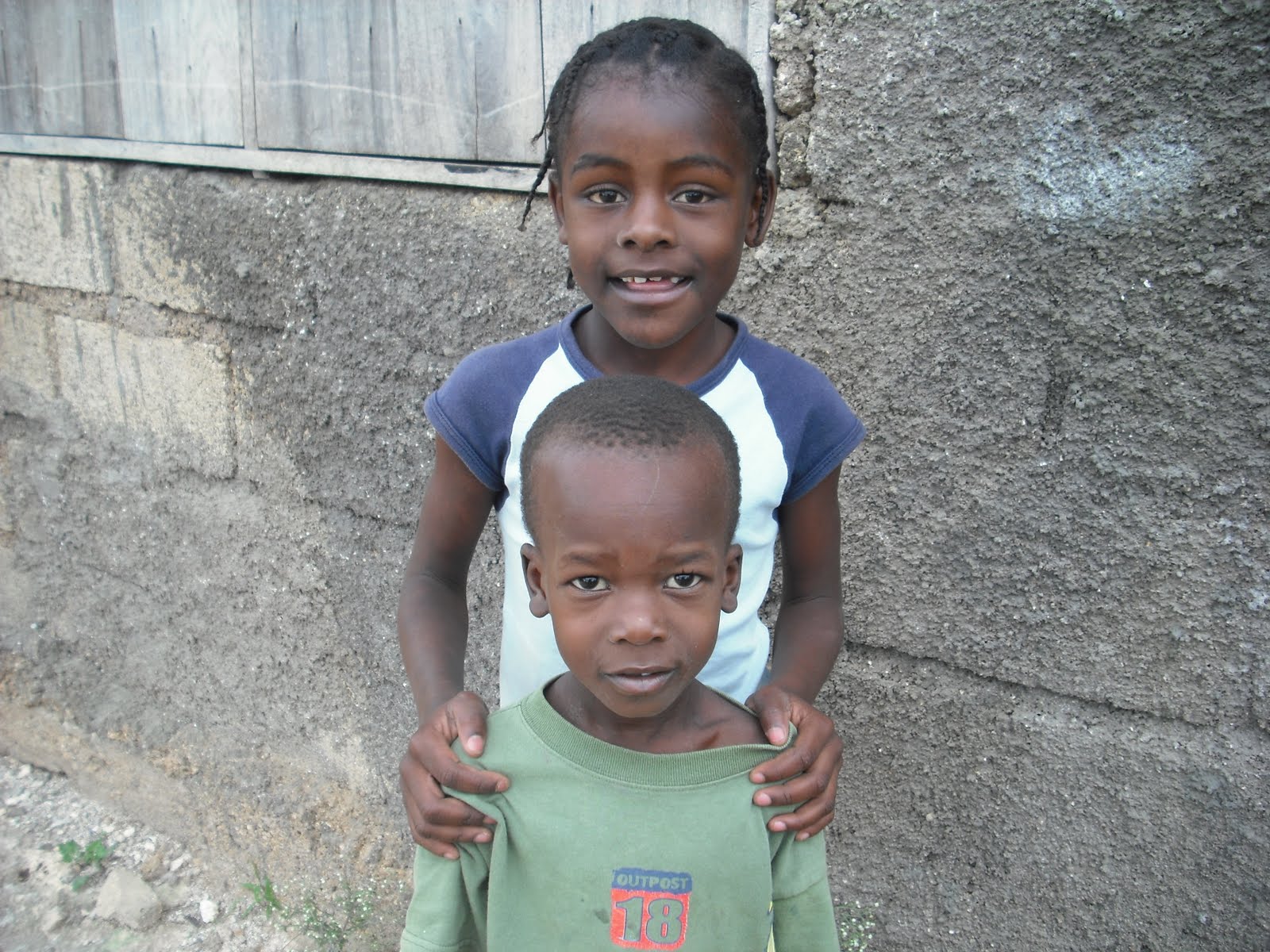
Number 4- Haitian children are uncomplaining. While staying with my rural hosting family, the family was standing up looking at the postcards of San Francisco and photos of my family that I had brought to show them. The youngest son- a little guy no more than 4 years old— well, here is a photo of him….

…the youngest son stood underneath everyone and clearly wanted to see the photos but they completely ignored him. He jumped up and down a couple of times to try to get a peek, but came up a good 2 feet short of being able to view anything. Eventually I saw that he was being left out, so I lifted him up to see. But the whole time he never said a word- he never cried or whined or complained. Now show me an American kid who acts like that.